Engineers believe skills get interviews.
Recruiters evaluate signals first.
Capable engineers get ignored every day, not because of their code, but because of the signals their resume, LinkedIn, and outreach send in the first seven seconds. This is the handbook and toolkit that fixes them.

Ex-Apple, Cisco, Adobe, Mastercard, and Visa.
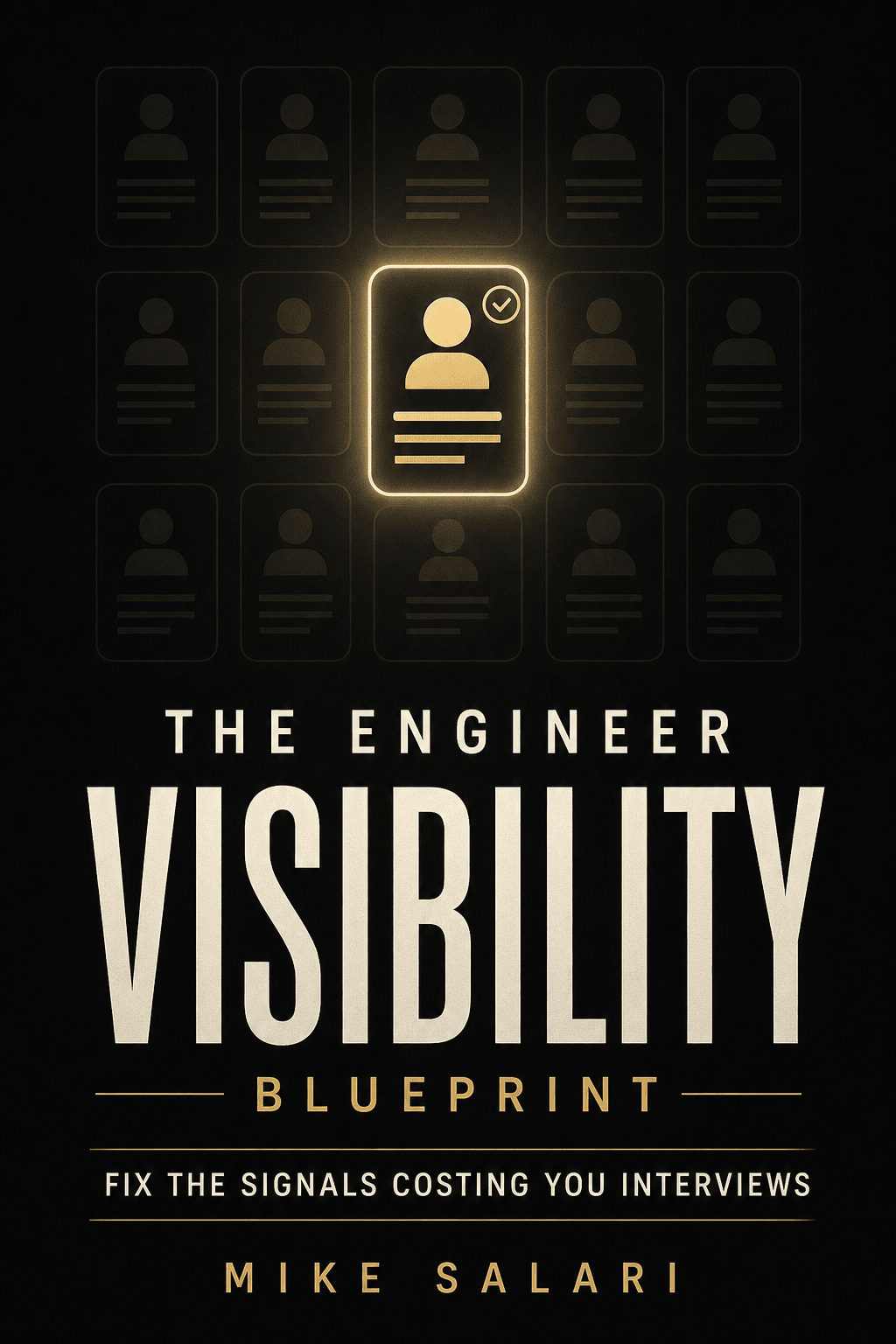
It is not a skills problem. It is a signal problem.
A recruiter has a queue of hundreds and seconds to spend on each one. They are not reading your code. They are scanning for reasons to stop. Every ambiguous signal is a reason to move on to the next applicant, and most engineers hand them several without knowing it.
The scan, not the read
Recruiters skim in seconds, not minutes. They decide whether you are worth a closer look before a single line of your experience is truly read.
The default answer
Advancing a weak candidate is a visible mistake. Skipping a strong one is invisible. So under pressure, the safe move is to say no. Your job is to remove every reason to.
Ambiguity reads as risk
"Software Engineer" tells a recruiter nothing they can match. Generic is unmatchable, and unmatchable gets skipped, never even rejected. Specific gets forwarded.
Signal vs Skill
Skill is what you can do. Signal is what a stranger can infer about you in seconds, from the outside, without testing it. Hiring filters on signal first and skill second, because signal is all a recruiter has at the top of the funnel.
What engineers think happens
- Skills
- Interview
- Offer
What actually happens
- Skills
- Visibility
- Interview
- Offer
The market cannot reward skills it never sees. Visibility is not vanity. Visibility is access.
Every surface a recruiter sees, fixed
The book walks each surface in turn and asks one question: what signal does this send? Then it shows the low-signal version, what the recruiter concludes, and the high-signal version that flips it.
Identity
Email, name, LinkedIn URL, photo, and the headline formula that makes you matchable instead of invisible.
Resume
The Action plus Problem plus Impact bullet formula, the skills trap, and the filename that signals the role before a word is read.
How recruiters actually search and source, the four-part About, and the consistency that reads as trust.
Outreach
Recruiter messages, referral asks, and follow-ups that read as low-risk and easy to say yes to.
The Visibility Score
A real 100-point self-audit with bands, so you know exactly where you stand and what to fix first.
The Upgrade Plan
A focused 30-minute pass that maps every action back to the signal it fixes. Do it in one sitting.
A real look at the pages
Not a teaser. Real spreads from the book: the diagnostic you score yourself with, the framework, and the signal cheat sheet recruiters never tell you about.
Start free. Go as deep as you need.
Begin with the free score, get the book to fix the signals, or take the toolkit and do the whole rewrite with done-for-you templates in one sitting.
- The 44-page book, PDF and EPUB
- The Signal vs Skill framework
- The 100-point Visibility Score
- Every low-signal to high-signal example
- The 30-minute Visibility Upgrade Plan
- Everything in the Blueprint
- The fillable Visibility Score workbook
- 25 resume bullet templates, every stack
- LinkedIn headline and About templates
- Recruiter and referral message scripts
- Editable Word versions of every template
Written from both sides of the desk
I have spent around 15+ years building software as a Staff Mobile Engineer at companies including Apple, Cisco, Adobe, Mastercard, and Visa. Across those years and hundreds of interviews on the screening side, I've reviewed thousands of resumes, LinkedIn profiles, and outreach messages. I know what makes a hiring team stop on a profile, and what makes them quietly move on.
It became impossible to ignore when I helped fill an open engineering role. More than 100 engineers sent me their resumes, LinkedIn profiles, and outreach. The same pattern appeared again and again, and almost none of it was technical. Capable people were filtering themselves out with vague headlines, half-finished profiles, duty-list resumes, and outreach that created friction instead of a conversation. No one would ever get far enough to find out how good they really were.
Years earlier I had invested heavily in understanding why equally skilled professionals get radically different opportunities, including a personal-branding program that cost me more than eight thousand euros. The answer was signals. The world does not evaluate you directly. It evaluates the signals you send, and hiring is no different.
This book distills both sides of that experience into a system you can run in an afternoon, whether you are early in your career or a staff engineer. It does not ask you to invent achievements or become someone you are not. It makes the experience you already have legible to the people deciding your next opportunity.
Frequently asked
Is this only for iOS or senior engineers?
No. The framework applies to every software engineer: backend, frontend, mobile, DevOps, data, and ML, from mid-level to staff. The examples cover every stack. Senior engineers often gain the most, because strong experience is frequently hidden behind unclear positioning.
What is the difference between the $69 book and the $99 toolkit?
The book gives you the understanding and the plan. The toolkit adds the done-for-you tools: a fillable score workbook, resume bullet templates, LinkedIn headline and About templates, recruiter and referral scripts, and editable Word versions, so you finish the rewrite in one sitting instead of starting from a blank page.
How long does it take?
You can read it in a focused 30 minutes. The Visibility Upgrade Plan is built to be done in one sitting, surface by surface.
What if I do not have much experience yet?
Visibility matters more when you have less to show, not less. The book helps you present the experience you do have clearly, point in a specific direction, and remove the small trust-killers that get early-career engineers skipped. It works the same whether you are junior or staff, and it never asks you to invent or inflate anything.
Is this interview or coding prep?
No. It does not teach you to pass the interview. It gets you the interview, by making sure your skills are actually seen. It is the step before the interview, not the interview itself.
Can I try before I buy?
Yes. Take the free Visibility Score. It is the real 100-point audit from the book, and it shows your number and weakest surface in two minutes.
Most engineers do not have a skills problem. They have a visibility problem.
Ex-Apple, Cisco, Adobe, Mastercard, and Visa.
Fix the signals. Then let your skills speak.
Get the handbook, run the 30-minute upgrade plan, and apply again, this time visible. Or start free with the Visibility Score and see your number right now.